
Category catalog
Refractory Accessories
Castables, mortars, and refractory cements are the monolithic side of refractory practice — materials placed wet and cured in position rather than laid as shaped units.
Products in Refractory Accessories
10 catalog items available for review




Understanding Refractory Accessories
Castables, mortars, and refractory cements are the monolithic side of refractory practice — materials placed wet and cured in position rather than laid as shaped units. Their advantage is geometric freedom. A furnace does not consist only of regular rings and arches; it has burner throats, kiln inlets and outlets, hoods, launders, tundishes, and dozens of irregular transitions where cutting brick to fit is slow, wasteful, and structurally weak. A castable conforms to any of these shapes, needs no inventory of special shapes, and can often be placed and dried within a single outage window, which matters enormously when the cost of the shutdown exceeds the cost of the materials many times over. Mortars serve a different but equally important role: they bond brickwork and close the joints that would otherwise be direct chemical penetration paths into the lining. Zenco Systems supplies refractory castables to 1750°C, mortars to 1500°C, and refractory cement concrete across Kenya and East Africa.
Supply & Delivery
Zenco Systems Ltd supplies Refractory Accessories to industrial buyers across East Africa. Availability, packaging, transport, and documentation are confirmed by the sales team before dispatch.
Castable, Mortar and Cement Product Forms
High alumina refractory castable (1750°C)
The highest-temperature castable, for severe duty — electric arc furnace positions, ladles, tundishes, thermal oxidisers, and abrasive kiln and calciner service.
Refractory castable (1600°C)
General-purpose castable for combustion chambers, burner blocks, fired heaters, furnace repairs, and irregular geometry across most industrial duty.
Refractory mortar (1500°C)
Bonding mortar for laying and jointing refractory brickwork, matched to the brick grade so the joint is not the weakest plane in the lining.
Refractory mortar Maxset-50 Fine (1500°C)
Fine-grade mortar for thin joints and precision brickwork where a close, uniform joint is required across the ring.
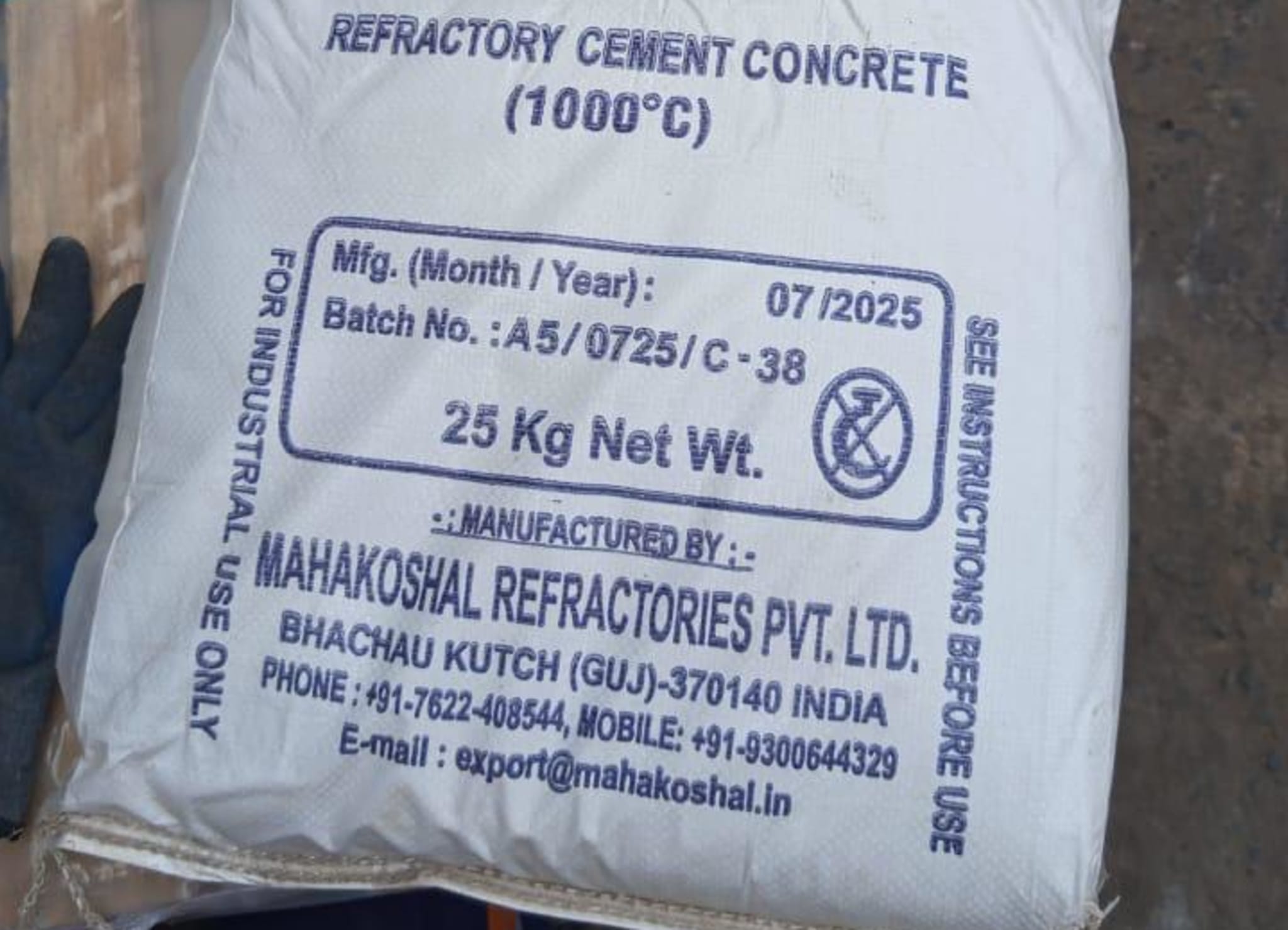
Refractory cement concrete (1000°C)
Lower-temperature refractory concrete for structural hot-face surrounds, foundations, and positions where moderate heat resistance and bulk placement are needed.
How to Choose the Right Refractory Accessories
Choose a castable over brick wherever geometry is irregular or the outage window is short, and choose the grade against the dominant wear mechanism rather than the peak temperature. High alumina castable at 1750°C is justified where chemical attack, molten contact, or severe abrasion govern — ladles, tundishes, EAF positions, and ore-handling kilns. The 1600°C general-purpose grade covers most combustion chamber, burner block, and fired heater duty at lower cost. Refractory cement concrete suits bulk placement and structural surrounds up to 1000°C where the duty is moderate. For mortars, the essential rule is to match the mortar to the brick grade: a mortar with a lower service temperature than the brick it beds becomes the weak plane in the lining and will fail first. Use the fine grade where thin, uniform joints are needed. In all cases the dry-out schedule is part of the specification, not an optional refinement.
Installation & Handling Notes
- Follow the published dry-out and curing schedule exactly — rapid heat-up traps free water and causes explosive spalling, the most common cause of premature castable failure.
- Match mortar service temperature to the brick grade; a lower-rated mortar becomes the weak plane and fails before the brick does.
- Check anchor condition and spacing before placing castable, since anchor failure is a frequent root cause misdiagnosed as material failure.
- Mix to the specified water content. Excess water is the single most common on-site error and permanently reduces the cured strength.
- Place castable in a continuous operation where possible; cold joints between placements become preferential wear and penetration paths.
Castable and Mortar Selection Compared
Castable vs refractory brick
Castable conforms to irregular geometry, needs no shaped inventory, and can be placed and dried inside a short outage. Brick gives a structurally sound ring with predictable campaign life on regular geometry. Most linings use both, in the positions each suits.
High alumina vs standard castable
The 1750°C high alumina grade earns its cost where chemical attack, molten contact, or severe abrasion govern — ladles, tundishes, EAF positions, abrasive kilns. The 1600°C grade is adequate and more economical for general combustion chamber and fired heater duty.
Refractory mortar vs refractory cement concrete
Mortar is a jointing material for bedding brickwork in thin layers. Refractory cement concrete is a bulk placement material for structural surrounds and foundations up to 1000°C. They are not substitutes for one another.
Standard vs fine grade mortar
Fine grade produces thin, uniform joints suited to precision brickwork where close jointing matters across the ring. Standard grade is appropriate for general bedding where joint thickness is less critical.
Refractory Accessories FAQs
When should I use a castable instead of refractory brick?
Where geometry is irregular — kiln inlets and outlets, burner throats, hoods, launders, tundishes — and where the outage window is short. Castable conforms to the shape, requires no inventory of special shapes, and can usually be placed and dried within a single shutdown, which matters when downtime costs far exceed material costs.
Why does refractory castable spall or explode on heat-up?
Because free water trapped in the cured castable flashes to steam faster than it can escape. This is almost always caused by heating faster than the published dry-out schedule allows, particularly in thick sections. Following the schedule is part of the specification, not an optional refinement.
What temperature rating do refractory castables have?
Our refractory castable is rated to 1600°C and the high alumina refractory castable to 1750°C, with refractory cement concrete at 1000°C for lower-temperature structural duty. Grade selection should follow the dominant wear mechanism — chemical attack, abrasion, or molten contact — rather than peak temperature alone.
Does refractory mortar need to match the brick grade?
Yes, and this is a common and costly oversight. A mortar with a lower service temperature than the brick it beds becomes the weakest plane in the lining and fails first, opening joints that then act as direct chemical penetration paths. Match the mortar to the brick rather than treating it as a generic consumable.
How much water should be added when mixing castable?
Exactly the specified amount. Excess water is the most common on-site error and permanently reduces cured strength and density — the material will never reach its rated performance regardless of how well it is subsequently installed and dried. Mix by measure rather than by consistency.
What is the difference between refractory mortar and refractory cement concrete?
Mortar is a jointing material applied in thin layers to bed brickwork. Refractory cement concrete is a bulk placement material for structural surrounds, foundations, and hot-face supports up to 1000°C. They serve different functions and cannot substitute for each other.
Can castable repairs be done during a short shutdown?
Often yes, which is a large part of their appeal — but the dry-out schedule has to be included in the outage plan rather than compressed at the end of it. Rushing heat-up to recover time typically causes spalling and costs far more time than the schedule would have taken.
Industries Using Refractory Accessories
Technical Guides
Selection and maintenance guidance from our engineering team.
Related Categories
Refractory Bricks
Refractory Bricks supplied by Zenco Systems Ltd for industrial, commercial, and institutional buyers across Kenya and East Africa.
Ceramic Fibre Products
Ceramic Fibre Products supplied by Zenco Systems Ltd for industrial, commercial, and institutional buyers across Kenya and East Africa.
Gaskets & Packings
Gaskets & Packings supplied by Zenco Systems Ltd for industrial, commercial, and institutional buyers across Kenya and East Africa.